Multi-Modal Clinical Decision Support Engine with Native DICOM De-Identification and Anomaly Localization
An enterprise-grade clinical decision support and medical image intelligence platform. Features browser-native zero-knowledge WebAssembly DICOM parsing, automated client-side HIPAA/DISHA PHI de-identification (stripping 18 metadata tags and masking pixel-level annotations), and Vision Transformer (ViT) heatmap localization for multi-center oncology and pulmonary diagnostics.
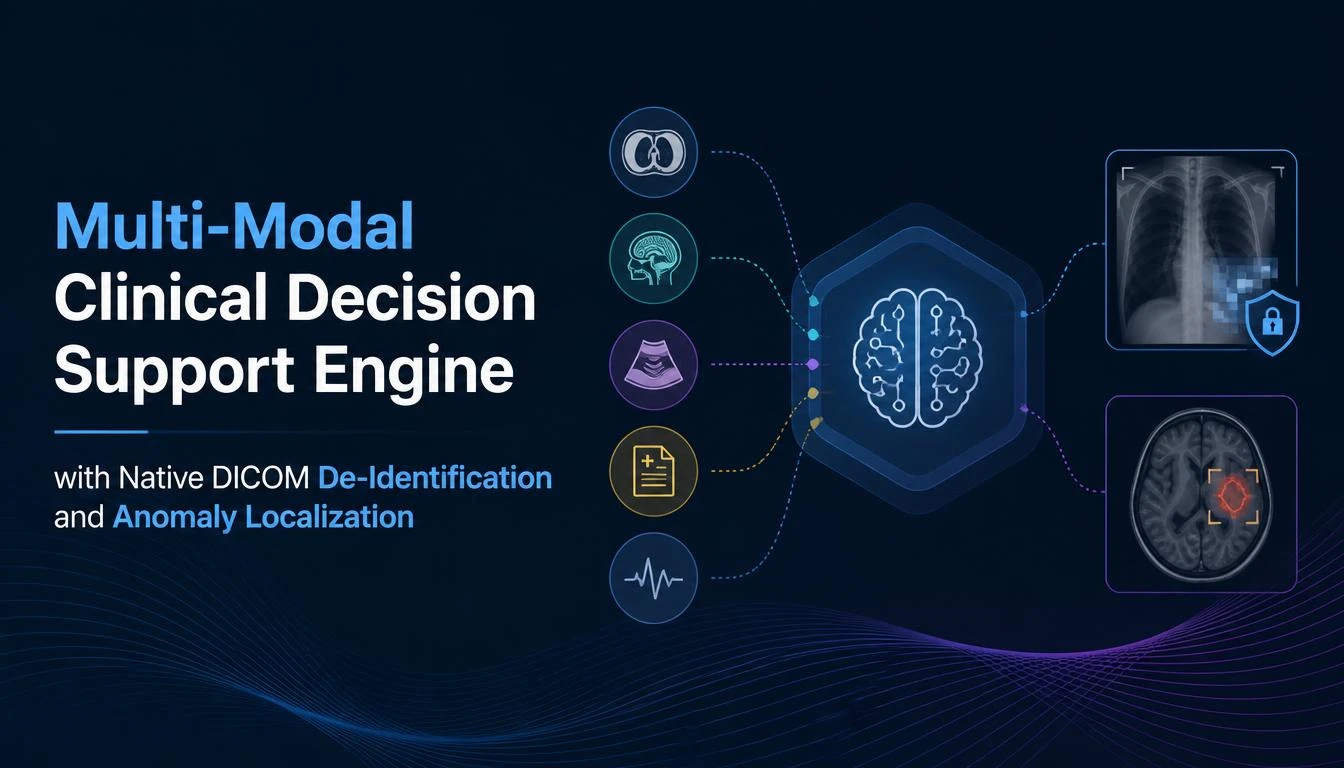
Detailed Project Overview
Clinical & Compliance Challenge
Multi-center medical research networks and tertiary hospitals frequently encounter significant bottlenecks when attempting to collaborate on diagnostic AI modeling or conduct multi-institutional clinical research. The primary obstacle is the rigorous protection of Protected Health Information (PHI) mandated by global regulatory standards (HIPAA, GDPR) and national health frameworks (India’s Digital Information Security in Healthcare Act - DISHA). Traditional DICOM de-identification pipelines either rely on server-side processing—which inherently violates zero-trust principles by transmitting raw PHI across networks—or fail to account for 'burned-in' demographic text rendered directly onto ultrasound, fluoroscopy, and legacy CT image pixels. Furthermore, radiologist burnout has reached critical levels, with diagnostic caseloads exceeding 200 high-resolution volumetric scans per specialist daily.
Architectural Blueprint & Zero-Trust Client-Side Redaction
Rubrich Technologies engineered an end-to-end, zero-trust medical software architecture combining in-browser privacy enforcement with deep learning diagnostic triage.
-
Browser-Native WebAssembly DICOM Sanitization Engine:
- Compiled a hardened C++ DICOM parser (based on DCMTK) into a high-performance WebAssembly (Wasm) binary running locally within the client's browser thread.
- Completely redacts all 18 standard HIPAA Safe Harbor header elements (patient name, MRN, date of birth, institutional identifiers, treating physicians) before byte streams leave client volatile memory.
- Deployed a specialized lightweight Optical Character Recognition (OCR) neural classifier to detect and black out burned-in pixel text within secondary capture images, ensuring complete visual anonymity.
-
Multi-Modal Vision Transformer (ViT) Anomaly Localization:
- Integrated a hybrid Vision Transformer (ViT-B/16) and 3D Attention UNet architecture running on an encrypted GPU microservice cluster.
- Generates volumetric segmentations and Grad-CAM attention heatmaps highlighting suspicious pulmonary nodules, focal ground-glass opacities, and cranial micro-hemorrhages.
- Delivers an explainability matrix providing probabilistic lesion classification alongside reference clinical literature grounding.
-
Full-Stack Clinical Workflow & FHIR Interoperability:
- Engineered with CornerstoneJS and WebGL hardware acceleration to deliver buttery-smooth 60 FPS multi-planar volumetric rendering (axial, sagittal, coronal) in a secure Next.js workstation interface.
- Bi-directional communication with existing Hospital Information Systems (HIS) and Picture Archiving and Communication Systems (PACS) using HL7/FHIR v4 REST APIs and DICOMweb protocols (WADO-RS, STOW-RS).
Tools & Technologies
The Objective
To architect a zero-trust, browser-native medical imaging suite capable of cryptographic PHI de-identification and explainable deep learning lesion localization across high-resolution DICOM datasets.
Key Features
- No specific features listed for this deployment.
Advanced Methodologies
Implementation Workflow
Project Outcomes
Ready to Start Your Project?
Partner with Rubrich Technologies for mission-critical deployments in enterprise software and research analytics.