Autonomous Edge Vision Inspection System for High-Speed Industrial Fabric Defect Detection
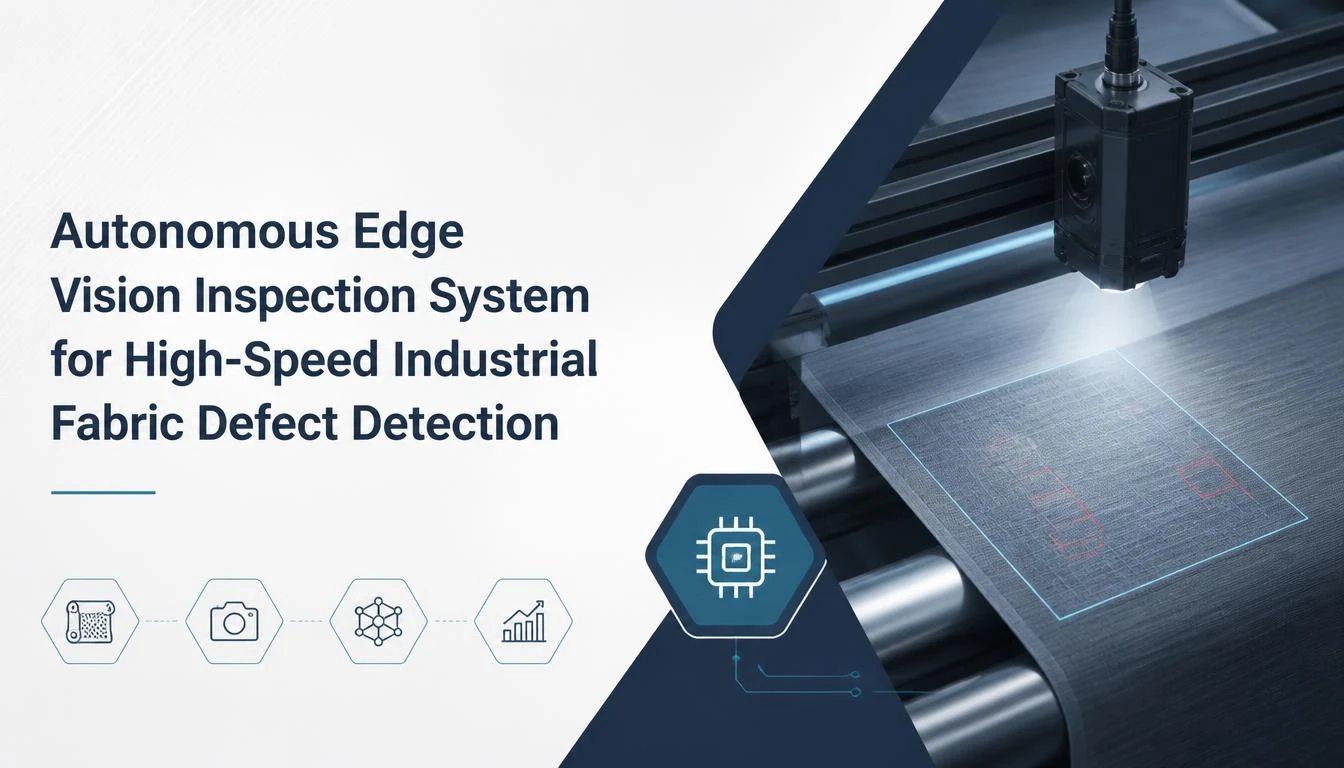
An ultra-low-latency edge AI computer vision platform deployed across high-speed weaving and circular knitting mills in Tiruppur. The system utilizes synchronized GigE line-scan cameras, TensorRT-quantized YOLO models, and sub-millimeter anomaly detection to inspect continuous textile webs moving at 40 meters per minute in real time.
Detailed Project Overview
Industrial Context & Engineering Challenge
Textile manufacturing hubs across South India—particularly in Tiruppur and Coimbatore—face severe financial penalties and shipment rejections due to structural weaving and knitting anomalies. Traditional quality assurance relies heavily on manual human inspection over perch tables, which achieves an average defect capture rate of only 60% to 65% due to operator visual fatigue, micro-stroboscopic lighting effects, and production line speeds exceeding 30 to 40 meters per minute. Missed anomalies such as broken picks, oil stains, needle lines, drop stitches, and selvage tears propagate into finished garment lots, resulting in devastating margin erosion and fabric waste.
System Architecture & Embedded Edge Pipeline
To address this challenge, Rubrich Technologies engineered a localized, decentralized Edge AI vision cluster capable of deterministic continuous-web defect localization at 120 frames per second with sub-5 millisecond end-to-end inference latency.
-
Optical Acquisition Rig:
- Dual 8K monochrome GigE Vision line-scan sensors positioned symmetrically above high-intensity diffuse LED backlights to maximize optical contrast on both plain-weave and high-density circular knit structures.
- Microsecond hardware rotary encoder triggering to eliminate motion blur and spatial stretching under fluctuating mill conveyor motor velocities.
-
Hardware Acceleration & Neural Network Architecture:
- Deployed on dedicated NVIDIA Jetson AGX Orin industrial edge computing modules mounted directly on the loom stanchions.
- Leveraged a customized YOLOv10 object detection and semantic segmentation backbone, heavily pruned and compiled using TensorRT 10.x with INT8 post-training quantization (PTQ) calibrated against 45,000 localized Tamil Nadu fabric defect samples.
- Implemented a spatial-temporal rolling window buffer in shared memory to correlate sequential scan lines and prevent boundary-cut defect misclassifications.
-
Real-Time Actuation & Telemetry Stack:
- Direct hardware GPIO integration with pneumatic marker solenoids that spray biodegradable UV-luminescent ink spots at the exact selvage coordinate of identified defects.
- Local SQLite ring-buffer coupled with a high-throughput WebSocket gateway streaming real-time bounding boxes, defect classification tags, and density heatmaps to an enterprise Next.js operator dashboard.
- Automated batch rollup synchronizing line quality telemetry with centralized factory ERP systems via lightweight MQTT protocols.
Tools & Technologies
The Objective
To architect and deploy an industrial-grade, deterministic edge vision inspection platform capable of real-time sub-millimeter textile defect localization at 40 meters/min with zero cloud dependency.
Key Features
- No specific features listed for this deployment.
Advanced Methodologies
Implementation Workflow
Project Outcomes
Ready to Start Your Project?
Partner with Rubrich Technologies for mission-critical deployments in enterprise software and research analytics.