Real-Time Anomaly Detection Engine with Automated Root-Cause Intelligence
An intelligent, real-time anomaly detection system powered by Python, TensorFlow, and Kafka that identifies statistical deviations in streaming data and automatically traces anomalies back to their root-cause variables with severity scoring.
Detailed Project Overview
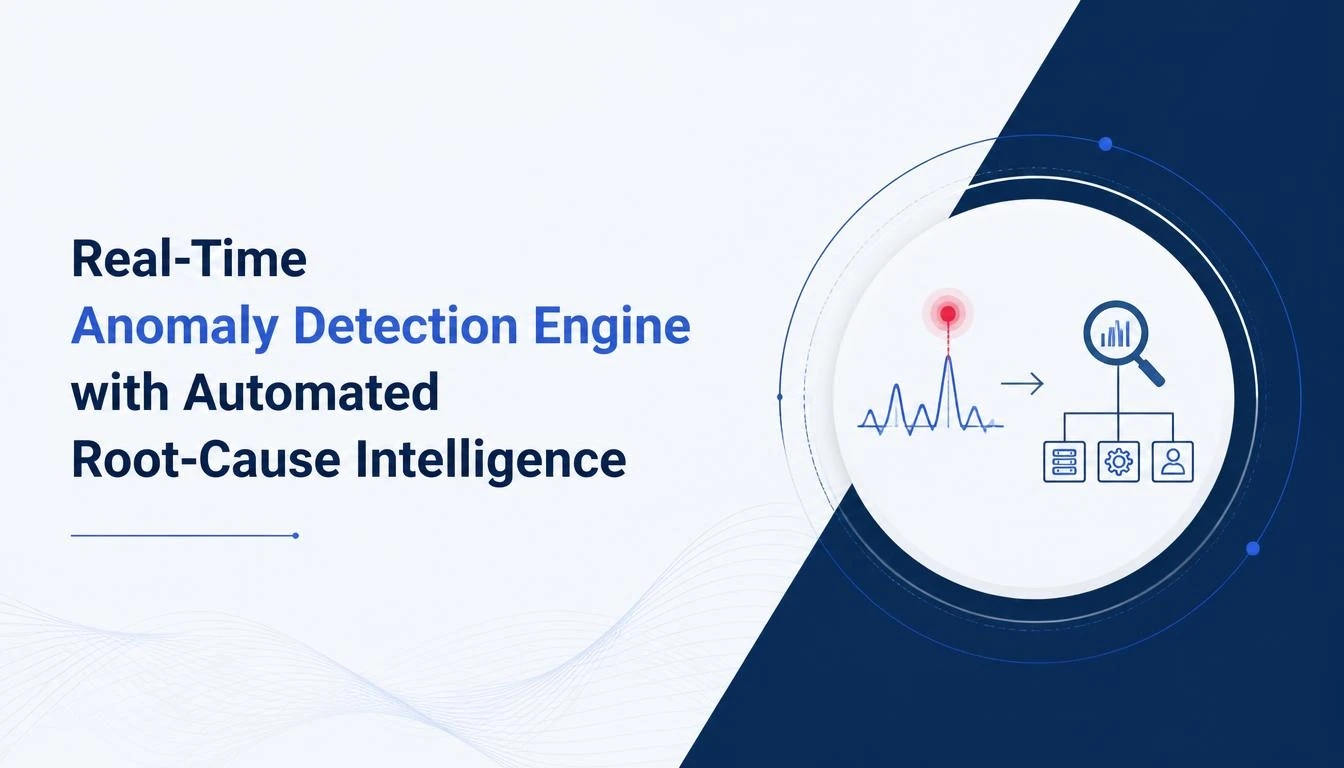
AnomalyIQ is an enterprise-grade anomaly detection platform designed to autonomously monitor high-volume streaming data across any B2B system—finance, manufacturing, supply chain, IT operations, or healthcare. Unlike traditional alerting systems that merely flag problems, AnomalyIQ leverages advanced machine learning to identify the exact ROOT CAUSE of deviations, drastically reducing investigation time from hours to minutes.
Built on Python with TensorFlow at its core, the system processes real-time data streams via Apache Kafka with microsecond latency. It employs a hybrid ensemble of Isolation Forests and Autoencoders to detect statistical anomalies with minimal false positives. The breakthrough feature is its automated root-cause attribution engine: once an anomaly is detected, the system performs multi-variate analysis to isolate which specific variables triggered the deviation, ranks them by impact contribution, and generates intelligent remediation suggestions.
The platform features a React + Next.js dashboard with WebSocket connectivity for live alert visualization, historical trend analysis, and drill-down investigation tools. Severity scoring is intelligent and context-aware, reducing alert fatigue by distinguishing critical deviations from natural business fluctuations. Integration with Slack, PagerDuty, and email ensures instant escalation for high-priority anomalies.
Tools & Technologies
The Objective
To eliminate blind spots in operational monitoring by transforming raw anomaly detection into actionable root-cause intelligence, enabling teams to respond to issues before they cascade into system failures or revenue loss.
Key Features
- Hybrid ML Ensemble: Isolation Forest + Autoencoder fusion for high-accuracy anomaly detection with minimal false positives.
- Automated Root-Cause Attribution: Multi-variate analysis engine that isolates exact variables triggering deviations.
- Real-Time Streaming Processing: Kafka integration for sub-second latency detection across millions of events.
- Intelligent Severity Scoring: Context-aware anomaly ranking that adapts to business-specific patterns and seasonality.
- WebSocket Live Dashboard: Interactive visualization of active anomalies, historical baselines, and drill-down investigation tools.
- Prescriptive Remediation Suggestions: AI-generated actionable steps to resolve each anomaly class.
- Multi-Channel Alerting: Smart escalation to Slack, PagerDuty, email, and custom webhooks based on severity.
- Historical Trend Analysis: Comparative visualization of current patterns vs. historical norms with statistical confidence intervals.
- Custom Baseline Learning: Adaptive thresholds that learn from domain-specific patterns, reducing tuning overhead.
Advanced Methodologies
Implementation Workflow
Project Outcomes
Ready to Start Your Project?
Partner with Rubrich Technologies for mission-critical deployments in enterprise software and research analytics.