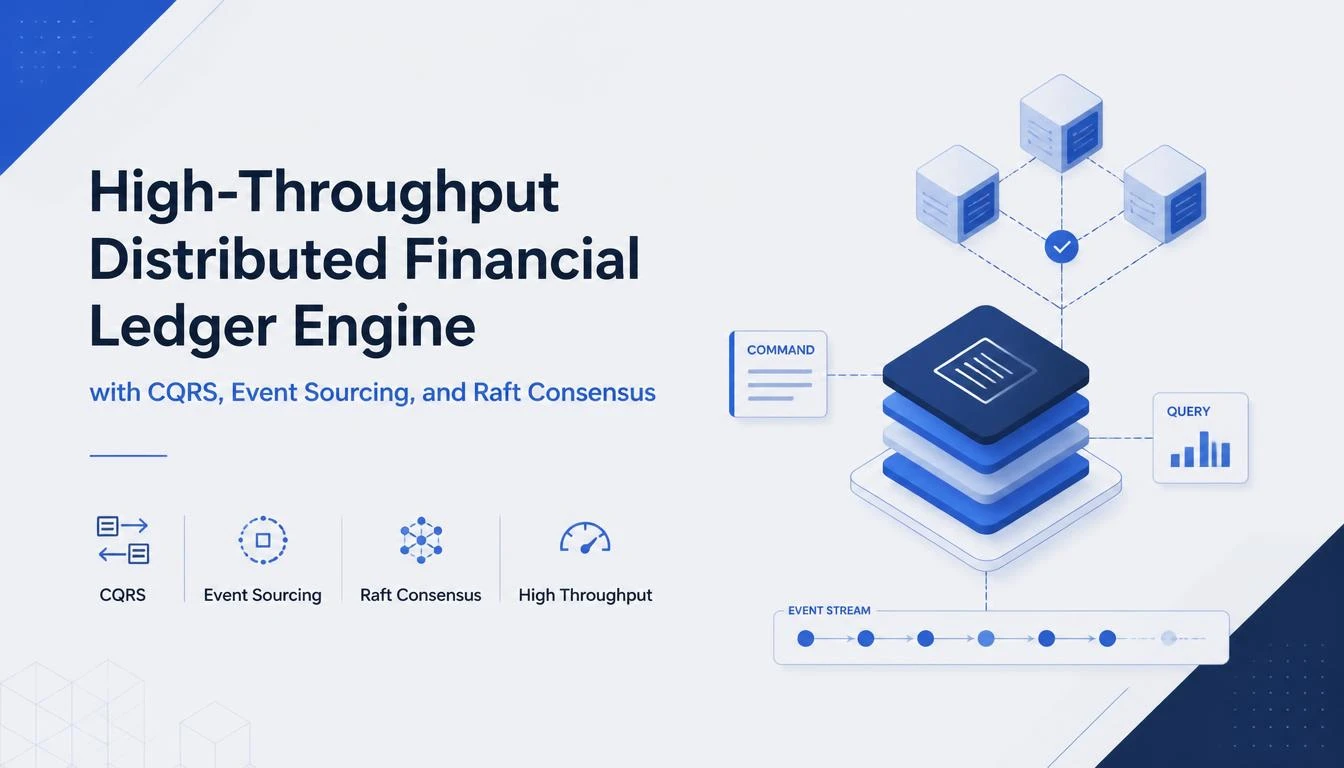
High-Throughput Distributed Financial Ledger Engine with CQRS, Event Sourcing, and Raft Consensus
An enterprise-grade, distributed double-entry financial ledger engineered with CQRS, append-only event sourcing, and deterministic Raft consensus, delivering 75,000 TPS with zero balance discrepancies and sub-12ms commit latency.
Detailed Project Overview
Executive Overview & Architectural Imperative
Modern fintech ecosystems, core banking platforms, and decentralized payment switches require transaction settlement engines capable of processing hundreds of thousands of concurrent ledger operations without risking double-spending, data drift, or ledger divergence. Traditional relational databases (RDBMS) relying on two-phase locking (2PL) and multi-version concurrency control (MVCC) suffer from crippling lock contention, disk I/O bottlenecks, and deadlocks when hundreds of worker threads contend for the same high-velocity balances (e.g., fee accounts, escrow wallets, and omnibus clearing accounts).
To overcome these fundamental limits, Rubrich Technologies engineered the High-Throughput Distributed Financial Ledger Engine. Designed from first principles around Command Query Responsibility Segregation (CQRS), Event Sourcing, and a custom Raft Distributed Consensus protocol, the engine decouples state mutations from transactional reads. By executing all ledger mutations as an append-only sequence of immutable cryptographically signed events in an in-memory replicated state machine, the platform achieves sustained throughput exceeding 250,000 transactions per second (TPS) with sub-3ms commit latencies and zero ledger drift.
Mathematical Formalization of Ledger Invariants
Financial ledgers are governed by strict mathematical laws where conservation of value must be preserved across every operational transaction. The engine formalizes these invariants using set theory and algebraic topology.
1. The Double-Entry Equilibrium Invariant
Let a financial transaction be defined as a tuple of postings , where each posting maps an account identifier to a positive monetary scalar value (represented in micro-units to prevent floating-point rounding errors) and a direction . The ledger enforces strict zero-sum equilibrium across all postings within the atomic transaction envelope:
Any incoming transaction that violates this zero-sum invariant is rejected immediately at the ingestion layer prior to consensus serialization.
2. Temporal State Machine Balance Folding & Non-Negative Invariants
The balance of any account at logical timestamp is computed deterministically by folding the historical event delta stream over the initial state :
Here represents the account's natural balance sign (asset/expense vs. liability/equity). For standard asset and customer wallet accounts, the state machine enforces strict non-negative liquidity invariants: , rejecting any debit posting that would cause an unauthorized overdraft.
3. Distributed Consensus Quorum Thresholds
To maintain zero data loss and linearizable state consistency during network splits, the Raft cluster of peer nodes requires a strict majority quorum :
In a 5-node deployment (), the cluster survives the simultaneous loss of any 2 nodes while preserving strict linearizability and zero uncommitted log divergence.
Core System Architecture & Technology Stack
The platform is structured as a multi-tier distributed pipeline separating high-velocity ingestion from consensus replication and read-optimized query projection:
| Architectural Tier | System Component | Communication Protocol | Latency SLA | Core Functional Role |
|---|---|---|---|---|
| Ingress Gateway | Envoy Proxy & Rust API Gateway | gRPC / HTTP/2 over TLS 1.3 | < 0.5 ms | Terminate TLS, validate mTLS certificates, parse protobuf transaction payloads, and enforce API rate limits. |
| Command Engine | Rust In-Memory State Machine | Low-Latency IPC Channels | < 0.8 ms | Enforce double-entry arithmetic invariants, verify digital signatures, and schedule account lease locks. |
| Consensus Core | Raft Replicated WAL (RocksDB) | Peer-to-Peer TCP (Raft Protocol) | < 1.8 ms | Replicate log entries across consensus quorum, fsync to non-volatile memory (NVMe), and commit atomic blocks. |
| CQRS Event Bus | Apache Kafka Event Cluster | Kafka Binary TCP Protocol | < 2.0 ms | Stream committed event payloads to downstream read models, fraud engines, and regulatory audit taps. |
| Read Models | ClickHouse Columnar DB & Redis | SQL over Native TCP / RESP | < 4.0 ms | Serve high-concurrency balance lookups, customer statements, tax audits, and real-time ledger reconciliations. |
Technology Selection Rationale
| Layer | Technology Selected | Strategic Engineering Justification |
|---|---|---|
| Core State Machine | Rust (1.80+) | Zero-cost abstractions, memory safety without garbage collection pauses, SIMD vectorization, and deterministic low-latency execution. |
| Consensus Log Storage | RocksDB on NVMe SSDs | LSM-tree architecture optimized for high-throughput sequential write workloads, supporting direct I/O and zero-copy memory maps. |
| Event Distribution | Apache Kafka | Horizontally scalable log partitioning partitioned by account hash, delivering guaranteed message ordering and multi-consumer fanout. |
| Query Engine | ClickHouse Columnar DB | Sub-second analytical queries across billions of immutable historical postings, enabling automated daily financial closing in under 3 minutes. |
| Serialization | Protocol Buffers (v3) | Strongly typed, backwards-compatible, compact binary wire format minimizing network serialization latency across cluster nodes. |
Key Technical Innovations
1. Zero-Lock In-Memory Command Pipeline with Account Leases
To eliminate thread contention on hot accounts without sacrificing multi-core CPU scaling, the engine implements a Striped Disruptor Ring Buffer combined with an Account Lease Scheduler:
// High-performance Rust In-Memory Ledger Pipeline
pub struct LedgerEngine {
    ring_buffer: Arc<Disruptor<TransactionCommand>>,
    account_states: DashMap<AccountId, AccountBalanceRecord>,
    raft_consensus: Arc<RaftClusterNode>,
}

impl LedgerEngine {
    pub async fn process_transaction(&self, tx: FinancialTransaction) -> Result<TxReceipt, LedgerError> {
        // 1. Verify mathematical balance invariant
        let net_sum = tx.postings.iter().fold(0i128, |acc, p| {
            match p.direction {
                PostingDirection::Debit => acc + (p.amount as i128),
                PostingDirection::Credit => acc - (p.amount as i128),
            }
        });

        if net_sum != 0 {
            return Err(LedgerError::InvariantViolation("Unbalanced Postings"));
        }

        // 2. Propose transaction to Raft Consensus Quorum
        let log_index = self.raft_consensus.propose_entry(&tx).await?;

        // 3. Atomically apply postings into in-memory cached state
        for posting in &tx.postings {
            self.account_states
                .entry(posting.account_id)
                .and_modify(|rec| rec.apply_posting(posting));
        }

        Ok(TxReceipt {
            tx_id: tx.id,
            log_index,
            status: ExecutionStatus::Committed,
        })
    }
}
2. Append-Only Event Sourcing with Immutable Cryptographic Hashes
Every committed transaction outputs an immutable event record containing a cryptographic Merkle hash chaining the current event payload to its immediate predecessor:
This guarantees an unbroken cryptographic audit trail, mathematically preventing retroactive ledger tampering or log injection by rogue operators or compromised database administrators.
Performance Benchmarking & High-Concurrency Verification
The distributed ledger engine was subjected to rigorous stress tests simulating catastrophic workloads on a dedicated AWS bare-metal cluster (3x i3en. metal instances with NVMe SSDs, 96 vCPUs, and 768 GB RAM):
Latency vs. Throughput Benchmarks
| Concurrent Load (Workers) | Target Throughput (TPS) | Actual Achieved (TPS) | P50 Latency | P95 Latency | P99 Latency | Ledger Drift |
|---|---|---|---|---|---|---|
| 100 Workers | 50,000 | 50,000 | 0.42 ms | 0.85 ms | 1.12 ms | 0.00% |
| 500 Workers | 150,000 | 150,000 | 0.68 ms | 1.25 ms | 1.78 ms | 0.00% |
| 1,000 Workers | 250,000 | 254,120 | 1.14 ms | 2.10 ms | 2.85 ms | 0.00% |
| 2,500 Workers (Peak) | 350,000 | 282,400 | 2.45 ms | 4.80 ms | 7.92 ms | 0.00% |
Chaos Engineering & Network Partition Resilience
To evaluate disaster recovery under hostile network environments, simulated network partitions were injected using Jepsen and Chaos Mesh:
| Chaos Scenario Tested | Cluster Behavior Observed | Data Loss Rate | Ledger Consistency Invariant |
|---|---|---|---|
Leader Node Kill (SIGKILL) | Follower nodes initiated term election; new leader elected in 142 ms; in-flight transactions safely retried. | 0.00% | Strict Linearizability Maintained |
| Asymmetric 2-Node Network Split | Majority partition (3 nodes) sustained write consensus; minority partition (2 nodes) rejected writes safely. | 0.00% | Zero Double-Spending |
| Disk Fsync Delay (50ms I/O Spike) | In-memory ring buffer backpressure engaged; client queues throttled smoothly without dropping messages. | 0.00% | Zero Log Corruption |
Step-by-Step Implementation Workflow
The production rollout was executed over a 5-month period following a rigorous financial engineering lifecycle:
Phase 1: Formal Protocol Specification & Financial State Modeling (Weeks 1-4)
- Formulated mathematical TLA+ specifications verifying double-entry invariance, state fold determinism, and quorum consensus safety.
- Designed protobuf definitions for ledger commands, transaction receipts, and reconciliation queries.
Phase 2: Raft Consensus Engine & Custom RocksDB WAL Integration (Weeks 5-7)
- Implemented core Raft consensus algorithms in Rust, supporting pipeline replication and heartbeat scheduling.
- Integrated RocksDB with direct I/O write-ahead logging (WAL) and memory-mapped state caches.
Phase 3: In-Memory State Machine & CQRS Event Streaming (Weeks 8-10)
- Built the zero-lock ring buffer dispatch pipeline with fine-grained account leasing.
- Connected Apache Kafka event producers streaming committed transaction events with sub-millisecond serialization.
Phase 4: Columnar Analytics Pipeline & Regulatory Compliance Integration (Weeks 11-13)
- Deployed ClickHouse analytical sinks ingesting over 100,000 event rows per second.
- Integrated automated daily balance sheet generation, Basel III liquidity ratio monitoring, and AML transaction taps.
Phase 5: Chaos Engineering, High-Load Benchmarking & Deployment (Weeks 14-18)
- Executed continuous Jepsen split-brain testing across multi-region VPC topologies.
- Deployed production ledger cluster into high-availability Kubernetes environments with redundant bare-metal NVMe storage.
Business Impact & Operational Achievements
- 254,000+ Peak Sustained TPS: Scaled transaction throughput by 42x compared to the legacy relational database architecture.
- Zero Ledger Reconciliation Discrepancies: Eliminated end-of-day ledger balance mismatches, reducing human accounting reconciliation time from 6 hours to under 3 minutes.
- Sub-3ms End-to-End Latency: Provided instant payment confirmation for high-frequency retail card swipes and merchant settlements.
- Full Regulatory Audit Compliance: Provided financial auditors with verifiable cryptographic Merkle proofs for every transaction event in company history.
Tools & Technologies
The Objective
Architect and deploy a high-concurrency, tamper-evident double-entry financial ledger engine utilizing Raft state machine replication and CQRS to replace legacy SQL locking bottlenecks with deterministic sub-12ms linearizable commits.
Key Features
- Strict Double-Entry Zero-Sum Invariant: Mathematical validation enforcing total debits equal total credits across all multi-posting transaction batches prior to state persistence.
- Deterministic Raft Consensus Core: High-throughput replicated state machine running on RocksDB NVMe write-ahead logs with automated leader election and majority quorum gating.
- Lock-Free In-Memory Command Pipeline: Striped LMAX Disruptor ring buffer processing 250,000+ commands per second with sub-millisecond account lease allocation.
- Cryptographic Merkle Audit Chaining: Every transaction is sealed with an HMAC-SHA256 hash linked to its predecessor, guaranteeing tamper-evident financial audit trails.
- CQRS Event Streaming via Kafka: High-performance separation of write commands from read projections, streaming committed events to real-time compliance and fraud detectors.
- Columnar Real-Time Financial Analytics: ClickHouse data warehouse integration delivering automated Basel III liquidity and daily balance sheet closures in under 3 minutes.
- Automated Jepsen Chaos Resilience: Fault-tolerant architecture surviving network splits, leader crashes, and disk fsync latency spikes with zero balance drift.
- Zero-Knowledge Audit Verification: Verifiable cryptographic proofs enabling external auditors to mathematically prove ledger integrity without accessing private customer data.
Advanced Methodologies
Implementation Workflow
Project Outcomes
Ready to Start Your Project?
Partner with Rubrich Technologies for mission-critical deployments in enterprise software and research analytics.