From Zero to Scopus: The Complete Checklist for Publishing Your First Engineering Research Paper
Publishing your first engineering research paper in a Scopus-indexed journal can be daunting. Follow this comprehensive, step-by-step checklist to ensure your manuscript is accepted.
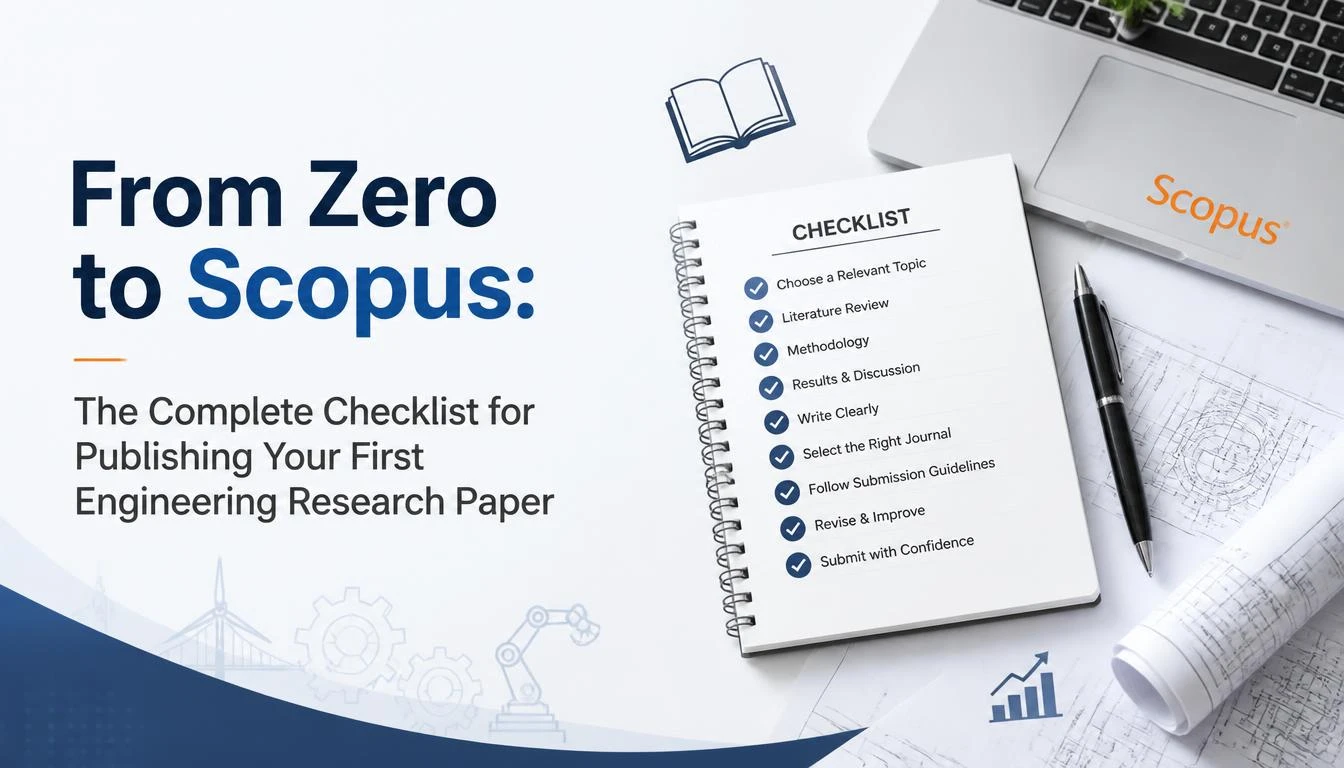
“Publishing your first engineering research paper in a Scopus-indexed journal can be daunting. Follow this comprehensive, step-by-step checklist to ensure your manuscript is accepted.”
Introduction: The High-Stakes World of Scopus Publishing
Publishing your first engineering research paper in a Scopus-indexed journal is a major milestone in any academic career. It is the defining moment that transitions you from a student consuming knowledge into a scholar producing it. However, the path to a successful publication is fraught with bureaucratic, formatting, and methodological pitfalls. Scopus is not a publisher itself; it is the world's largest abstract and citation database of peer-reviewed literature. Being indexed in Scopus guarantees that a journal meets strict quality and ethical standards. Consequently, the journals indexed within it are fiercely competitive.
Many early-career researchers make the fatal assumption that excellent laboratory results or groundbreaking simulations are enough to guarantee publication. This is a myth. The reality is that over 60% of submissions to top-tier engineering journals are rejected at the 'desk'—meaning the Editor-in-Chief dismisses the paper before it even reaches peer reviewers. Why? Because the manuscript fails to adhere to the rigid structural and strategic requirements of academic publishing.
This comprehensive, step-by-step checklist is designed to demystify the entire publication pipeline. We will break down the process into actionable phases: from selecting the absolute perfect journal and navigating the complex landscape of impact metrics, to structuring your manuscript for maximum readability, optimizing your methodology for reproducibility, and finally, surviving the brutal cross-examination of the peer-review process.
Phase 1: Pre-Writing Strategy and Journal Selection
The biggest strategic error a PhD scholar can make is writing the manuscript first and looking for a journal later. This backwards approach inevitably leads to a poor fit between the paper's scope and the journal's audience. Your first step must always be identifying the exact journal you want to target.
Begin by analyzing the 'Aims and Scope' of potential journals. If your research involves the practical deployment of IoT sensors in a smart city, a journal dedicated to theoretical physics and complex mathematical modeling will reject your paper immediately, regardless of its quality. Use tools like the Elsevier Journal Finder, Springer Journal Suggester, or IEEE Publication Recommender. Input your abstract, and these tools will cross-reference your keywords against thousands of active journals.
Once you have a shortlist, you must verify their indexing status. Do not trust a journal's website claiming 'Scopus Indexed.' Predatory journals routinely lie about their credentials to extort Article Processing Charges (APCs) from desperate students. Always go directly to the official Scopus Source List (scopus.com/sources) and search for the journal's ISSN. If it is not on the official list, do not submit.
Finally, evaluate the journal's metrics. Understand the difference between CiteScore, SCImago Journal Rank (SJR), and Source Normalized Impact per Paper (SNIP). A Q1 journal (top 25% in its field) carries immense prestige but often has a rejection rate exceeding 80% and a review cycle taking up to a year. If you are under a tight university deadline, it may be more strategic to target a highly reputable Q2 or Q3 journal with a faster 'Time to First Decision' metric.
Technical Takeaways
Phase 2: Structuring the Manuscript (The IMRaD Blueprint)
The vast majority of engineering journals demand the IMRaD structure: Introduction, Methods, Results, and Discussion. Deviating from this structure confuses reviewers and invites desk rejection. Let us dissect how to optimize each section.
The Introduction is your sales pitch. It must do three things: establish the context of the field, critically review recent literature, and explicitly define the 'Research Gap.' Do not simply list what other authors have done. You must synthesize the literature to highlight what is missing. A powerful introduction culminates in a clear, declarative statement: 'While previous studies have optimized parameter X, none have addressed its behavior under condition Y. This paper aims to bridge this critical gap.'
The Methodology section is the engine of your paper. In engineering, reproducibility is the ultimate benchmark of quality. If a peer reviewer cannot understand your experimental setup, mathematical models, or simulation parameters well enough to replicate your exact results, your paper will be rejected. Include detailed system architecture diagrams, state exact hardware specifications (e.g., 'An NVIDIA RTX 4090 GPU was utilized for training the CNN'), and explicitly list the hyperparameters of any algorithms used.
Phase 3: Mastering Data Visualization and Results
Engineering research is inherently visual. When an Editor or Reviewer opens your manuscript, the first things they look at are your figures and tables. If your graphs look like they were exported using default settings in Microsoft Excel, your credibility is instantly compromised. High-impact journals demand high-resolution, vector-based graphics.
You must use professional data visualization tools such as MATLAB, Python (Matplotlib/Seaborn), OriginPro, or TikZ (for LaTeX users). Ensure that all axes are clearly labeled with appropriate units, legends are legible without magnification, and the color schemes are accessible (e.g., colorblind-friendly palettes).
When writing the Results section, present the data objectively without interpretation. Save the interpretation for the Discussion section. The Discussion is where you explain *why* the results occurred based on physical or mathematical principles. Crucially, you must compare your novel results directly against the state-of-the-art baselines you established in your literature review. Prove to the reviewer that your proposed algorithm reduces latency by 15% compared to the industry standard.
Phase 4: Pre-Submission Optimization and The Cover Letter
A groundbreaking engineering discovery will be rejected if it is buried in terrible formatting and poor grammar. The peer-review system is heavily backlogged, and reviewers are unpaid volunteers. They have zero tolerance for sloppy manuscripts.
First, download the specific LaTeX or Word template provided by your target journal. Adhere strictly to their formatting guidelines regarding font sizes, margin widths, and citation styles (e.g., IEEE vs. APA). If the journal demands IEEE numbered citations and you submit APA author-date citations, the Editor will assume you are blindly mass-submitting the paper to multiple journals.
Second, run a rigorous plagiarism check using Turnitin or iThenticate. Aim for a similarity index below 15%. Be hyper-vigilant about 'Patchwriting'—the act of replacing a few words in a copied sentence with synonyms. Algorithms will flag the syntactic structure.
Finally, craft a compelling Cover Letter. This is your direct line of communication with the Chief Editor. Do not write a generic two-sentence email. Summarize the core novelty of your research in bullet points and explicitly state why your findings are of critical interest to the journal's specific readership.
Phase 5: Navigating the Peer Review Crucible
Once submitted, you enter the waiting game. If you survive the initial editorial screening, your paper is sent to 2 to 4 independent peer reviewers. After several months, you will receive one of four decisions: Accept, Minor Revision, Major Revision, or Reject.
Receiving a 'Major Revision' is actually a massive victory. It means the journal is interested in publishing your work, provided you can address the reviewers' concerns. When you receive the feedback, do not take the criticisms personally. Reviewers are evaluating the science, not your worth as an engineer.
Your response to the reviewers must be a masterpiece of diplomacy and scientific rigor. Create a document titled 'Response to Reviewers.' Copy every single comment made by the reviewers, and below it, write a detailed response explaining exactly how and where you modified the manuscript to address their concern. If a reviewer suggests an experiment that is outside the scope of your research, respectfully decline, but justify your decision with citations to existing literature.
Conclusion: The Beginning of Your Scholarly Identity
Publishing in a Scopus-indexed engineering journal is a marathon, not a sprint. It demands extreme meticulousness, a thick skin for criticism, and a strategic understanding of the academic publishing industry.
By following this comprehensive checklist—starting with rigorous journal selection, executing the IMRaD structure perfectly, utilizing professional data visualization, and mastering the art of the peer-review rebuttal—you will not only guarantee the publication of your first paper but also lay a rock-solid foundation for a prolific and highly cited academic career.