Python vs. MATLAB for Engineering Research Simulation: A Practical Comparison for PhD Researchers
Choosing the right simulation environment is critical for your PhD. Dive into a comprehensive technical comparison between Python and MATLAB for engineering research.
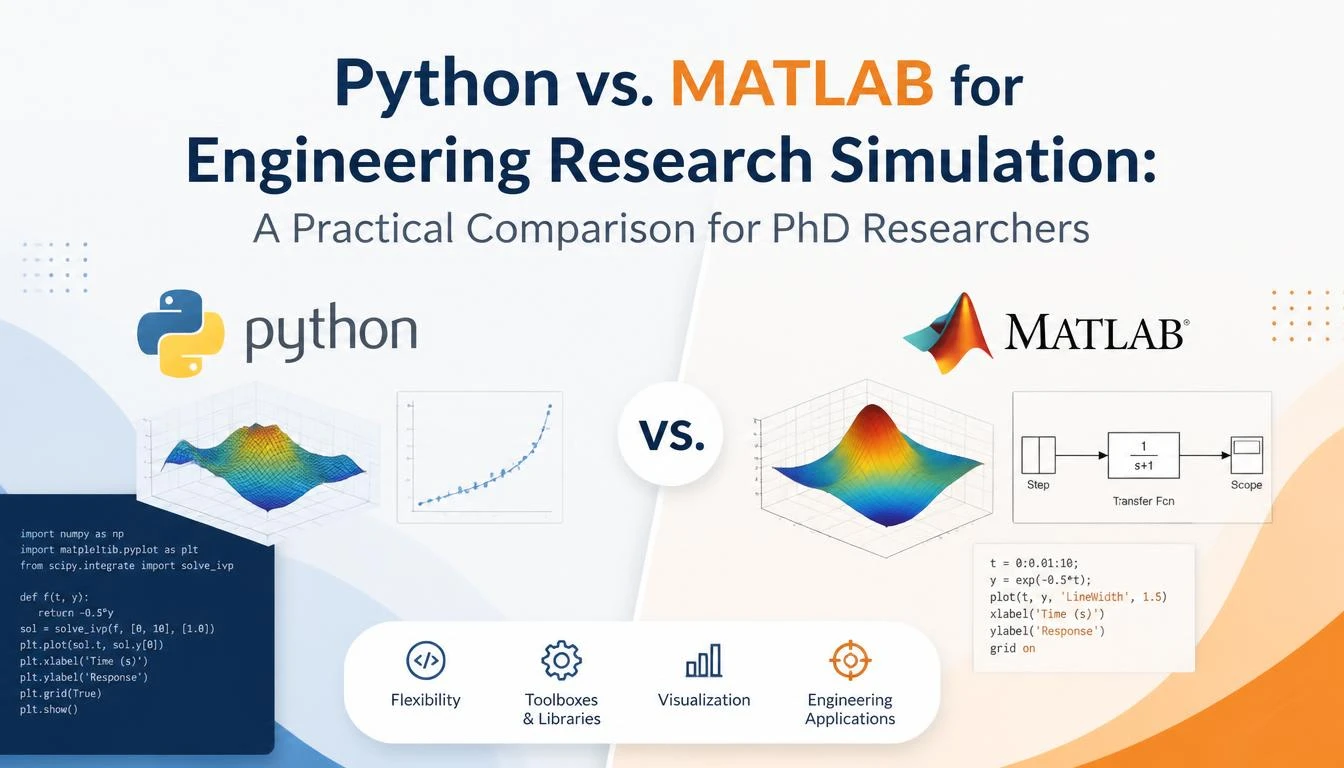
“Choosing the right simulation environment is critical for your PhD. Dive into a comprehensive technical comparison between Python and MATLAB for engineering research.”
The Core Dilemma for Engineering Scholars
For over three decades, MATLAB has been the undisputed heavyweight champion of engineering research and academic simulation. Originating as a 'Matrix Laboratory,' it provided generations of electrical, mechanical, and aerospace engineers with a robust, heavily vetted ecosystem. From classical signal processing to multi-body dynamic control systems, its proprietary toolboxes provided everything a PhD scholar needed out-of-the-box, ensuring that researchers spent their time analyzing physics rather than debugging code.
However, over the last five to seven years, a seismic paradigm shift has occurred. Python, a general-purpose programming language, has aggressively encroached upon MATLAB's exclusive territory. Driven by the absolute explosion of machine learning, massive open-source communities, and profound cost advantages, Python is no longer just a computer science tool—it is rapidly becoming the lingua franca of modern computational engineering.
Choosing the wrong environment at the very start of your PhD research can be a catastrophic strategic error. It can cost you hundreds of hours in redundant development time, severely limit the computational scalability of your simulations, or render your research entirely incompatible with your target industry. If your base paper uses advanced Python deep learning libraries, attempting to recreate those architectures in MATLAB from scratch is computational suicide. Conversely, if you are working on highly specific, hardware-in-the-loop control theory simulations, Python's open-source ecosystem currently lacks the visual maturity and industrial trust of MATLAB's Simulink.
This comprehensive, deeply technical guide compares both ecosystems across critical vectors: mathematical computation speed, physical system modeling, artificial intelligence integration, cost, and the rising global movement of 'Open Science.' By the end of this analysis, you will have a clear, strategic framework for choosing the right simulation environment for your thesis.
1. Mathematical Computation: Matrices vs. Objects
At its core, engineering simulation is applied linear algebra. MATLAB was designed from the ground up to solve massive matrix equations natively. For scholars in electrical engineering (signal processing), civil engineering (finite element analysis), or structural mechanics, writing code in MATLAB feels incredibly intuitive. The notation closely mirrors standard mathematical equations, and the underlying execution engine (utilizing BLAS and LAPACK libraries) is highly optimized for vectorization.
Python, conversely, is an object-oriented programming language. It requires external libraries—most notably NumPy and SciPy—to handle matrix operations efficiently. While NumPy is extraordinarily fast because its core operations are written in highly optimized C, the syntax is undeniably more verbose. Instead of writing pure equations, you are calling methods on array objects.
For pure, out-of-the-box mathematical ease of use, MATLAB still holds a slight edge for traditional engineers. However, once a researcher overcomes the initial learning curve of Python's NumPy syntax, the two languages are functionally equivalent in terms of computational capability. In fact, for extremely large datasets requiring distributed computing clusters, Python's integration with big data frameworks like Dask and PySpark often outpaces MATLAB's native parallel computing toolboxes.
2. Simulation and Physical Modeling: The Simulink Monopoly
When comparing physical system modeling, the conversation inevitably centers on one tool: Simulink. This is where MATLAB pulls ahead significantly for traditional engineering disciplines. Simulink is an unparalleled, industry-standard block diagram environment for multidomain simulation and Model-Based Design.
If your PhD involves simulating complex national power grids, electric vehicle drivetrain harmonics, or aerospace flight dynamics, Simulink allows you to build complex, non-linear differential physical models visually. You can drag and drop a PID controller, connect it to a virtual DC motor, and simulate the step response in seconds. Furthermore, Simulink generates highly reliable, production-ready C/C++ code that can be deployed directly onto microcontrollers for Hardware-in-the-Loop (HIL) testing.
Python currently lacks a direct, 1:1 competitor to Simulink that matches its decades of industry vetting and maturity. While open-source libraries like PyDy (Python Dynamics for multi-body systems) or SimPy (for discrete-event simulation) exist, they are heavily code-centric. They lack the visual, block-based interface that makes rapid prototyping so fast in MATLAB.
Therefore, if your thesis relies entirely on classical control theory, multi-domain physical dynamics, or strict automotive/aerospace industry standards (like ISO 26262), MATLAB and Simulink remain strictly mandatory.
3. Machine Learning and AI: Python's Absolute Dominance
The engineering paradigm has fundamentally shifted. Almost every modern PhD thesis now incorporates some form of Artificial Intelligence. Mechanical engineers are using Convolutional Neural Networks (CNNs) for acoustic defect detection in manufacturing; electrical engineers are using Deep Reinforcement Learning to optimize smart grid load balancing.
In the domain of Artificial Intelligence and Data Science, Python absolutely obliterates MATLAB. Python is the native language of AI. The entire global ecosystem of machine learning revolves around Python frameworks like TensorFlow, PyTorch, and Scikit-Learn. These are open-source industry standards developed and continuously updated by tech giants like Google and Meta. When a groundbreaking new AI algorithm is published at a top conference (like NeurIPS or CVPR), the open-source code is released in Python. If you want to use the absolute state-of-the-art in AI, you must use Python.
MathWorks has undoubtedly recognized this threat and introduced Deep Learning toolboxes for MATLAB. While these toolboxes are well-designed and feature a user-friendly GUI for training networks, they consistently lag behind Python's cutting-edge capabilities by 12 to 18 months. Furthermore, they lack the massive community support that PyTorch enjoys. If your research involves heavy AI/ML integration, or if your base paper utilizes an advanced neural network architecture, fighting to implement it in MATLAB is a massive waste of time. Python is the clear and unassailable winner.
4. Cost, Accessibility, and the 'Open Science' Movement
Cost is the silent variable that dictates much of academic research. MATLAB is proprietary, closed-source commercial software. A single commercial license can cost thousands of dollars, and every specialized toolbox (e.g., Signal Processing, Computer Vision) costs extra. While your university likely provides a campus-wide academic license, this becomes a severe bottleneck when you graduate, collaborate with international researchers in developing nations, or attempt to transition your academic algorithm into a commercial startup.
Python is 100% free and open-source. Anyone in the world with an internet connection can download Python, clone your GitHub repository, and run your simulations instantly without spending a single dollar on licensing fees.
This accessibility perfectly aligns with the rising global 'Open Science' movement. High-impact journals (like Nature and IEEE Transactions) increasingly demand that researchers publish their raw code alongside their manuscripts to guarantee reproducibility. Reviewers are far more likely to trust and replicate your findings if they can run your code freely via a Jupyter Notebook or Google Colab, rather than navigating complex MATLAB license server authentications. By choosing Python, you ensure your research has maximum global reach and citation potential.
5. The Best of Both Worlds: The Hybrid Co-Simulation Approach
For many advanced PhD scholars, the choice is no longer binary. The most sophisticated research methodologies increasingly leverage a hybrid approach, utilizing both ecosystems for their respective strengths through Co-Simulation.
Using the official MATLAB Engine API for Python, researchers can write master scripts in Python that dynamically call MATLAB functions or even run Simulink models in the background. In this paradigm, you might build a highly complex physical model of a robotic arm in Simulink, because doing so in Python would be too difficult. However, instead of using MATLAB's limited AI tools, you use PyTorch to train a Reinforcement Learning agent in Python.
The Python script feeds action commands into the Simulink model via the API, the Simulink model simulates the physics, and it returns the resulting state back to Python for the neural network to analyze. This hybrid pipeline allows you to leverage MATLAB's unassailable physical modeling alongside Python's cutting-edge artificial intelligence, creating a robust, highly publishable research framework.
Conclusion: Making Your Strategic Decision
Choosing between Python and MATLAB is fundamentally a strategic decision about your research domain and your post-PhD career trajectory.
If your research is heavily focused on classical control systems, hardware-in-the-loop deployment, or complex multi-domain physical modeling—and especially if you plan to enter the traditional aerospace or automotive industries—MATLAB and Simulink remain your strongest allies.
If your research involves heavy data science, machine learning, computer vision, or massive datasets—or if you plan to transition immediately into a Silicon Valley tech role, a quantitative finance position, or an AI startup—Python is strictly mandatory. Master the language of the future, and your research will scale without limits.