Event-Driven Microservices: Kafka vs. RabbitMQ for High-Throughput Next.js Enterprise Backends
A comprehensive 2026 architectural breakdown comparing Apache Kafka 4.2+ KRaft and RabbitMQ 4.0+ for high-throughput Next.js enterprise backends. Explore message models, Share Groups, Quorum Queues, latency benchmarks, and resilience patterns.
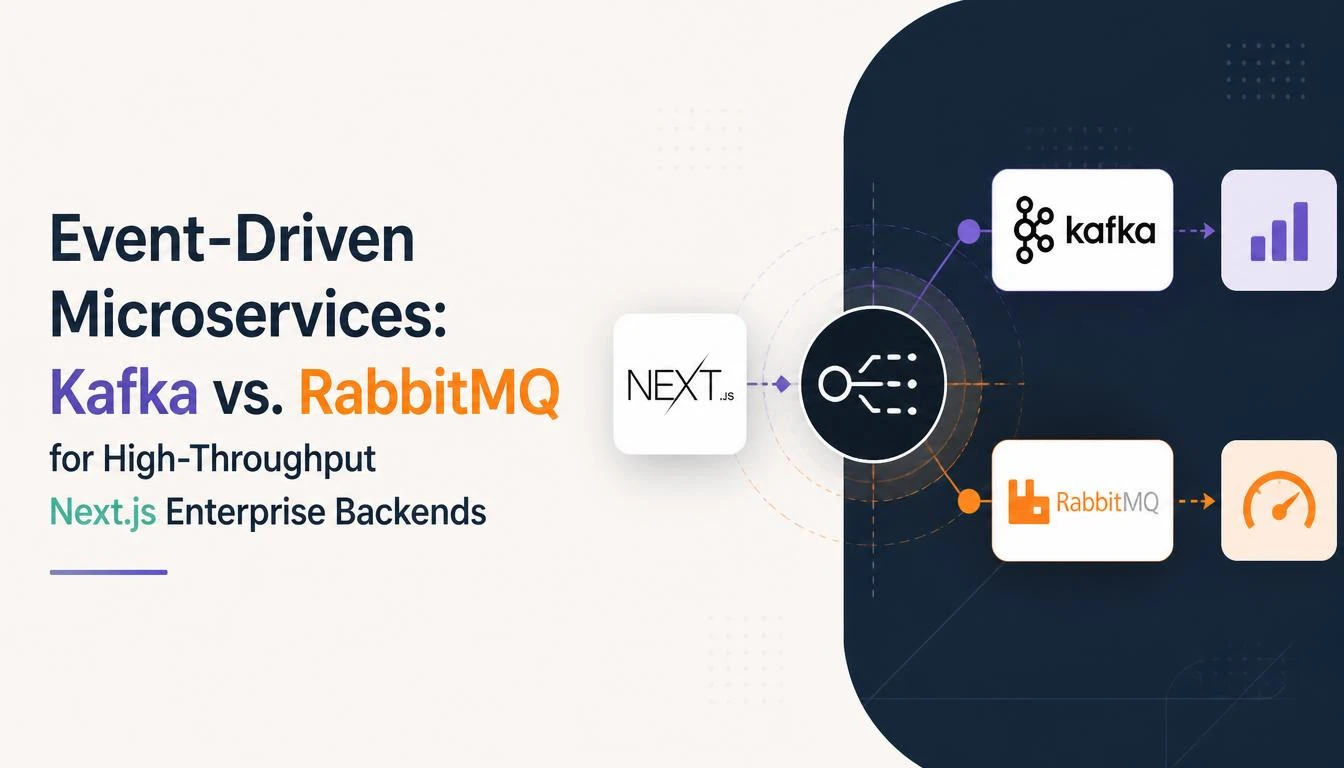
“As modern Next.js 16 applications scale into distributed enterprise meshes, synchronous HTTP coupling creates catastrophic latency cascades and resource exhaustion. This deep technical architectural guide provides CTOs and lead systems architects with a rigorous comparative benchmark of Apache Kafka 4.2+ and RabbitMQ 4.0+. We explore fundamental log-centric vs. broker-centric mechanics, zero-copy sequential disk I/O, Kafka Share Groups, RabbitMQ Quorum Queues, Next.js Server Action producer patterns, Transactional Outbox implementation, and dead-letter recovery strategies.”
The Modern Distributed State Dilemma in Next.js Enterprise Systems
Modern enterprise web development in 2026 has witnessed a radical transformation in how frontend and backend architectures converge. Frameworks like Next.js 16 have popularized unified full-stack development through Server Components, Route Handlers, and Server Actions. However, as organizations scale from monolithic architectures to globally distributed microservice meshes, the limitations of synchronous HTTP/REST and gRPC communication become painfully evident. When an e-commerce checkout, an algorithmic financial transaction, or a complex AI document pipeline executed via a Next.js Server Action relies on sequential, blocking HTTP requests across four downstream microservices, the cumulative latency explodes, and the entire transaction's reliability degrades to the weakest link in the network chain.
In high-throughput enterprise environments handling hundreds of thousands of events per second, synchronous coupling is an architectural anti-pattern. If a downstream notification service, an invoicing ledger, or an inventory database experiences a transient network partition or CPU throttle, the upstream Next.js edge runtime or Node.js server container is forced to maintain open TCP sockets, tying up event-loop thread pools and exhausting connection limits. This cascading failure pattern—often culminating in catastrophic 504 Gateway Timeouts and runaway serverless infrastructure bills—mandates the transition to an asynchronous, Event-Driven Architecture (EDA).
At the heart of any resilient event-driven enterprise architecture lies the message broker. For more than a decade, the architectural discussion has inevitably centered around two titan platforms: Apache Kafka and RabbitMQ. Yet, as both systems have introduced revolutionary architectural updates—most notably Apache Kafka 4.2 operating in pure ZooKeeper-less KRaft mode with new Share Group queue semantics, and RabbitMQ 4.0 standardizing Raft-backed Quorum Queues while refining native streams—the boundaries between log-centric streaming and broker-centric message queuing have become subtle, complex, and critical to understand.
Fundamental Architectural Foundations: Log-Centric Streaming vs. Broker-Centric Queuing
To architect an enterprise system with confidence, software engineers and enterprise architects must look beneath API abstractions and analyze how Kafka and RabbitMQ manage memory, disk I/O, state, and concurrency. At their core, the two platforms embody diametrically opposed distributed computing philosophies: the distributed commit log versus the intelligent, stateful message broker.
Apache Kafka is fundamentally an append-only, distributed commit log. When a Next.js application publishes an event payload to a Kafka topic, that message is serialized, appended to the tail of an immutable, sequential disk segment within a specific partition, and assigned a monotonically increasing 64-bit integer called an offset. Kafka brokers do not track whether individual consumers have read or acknowledged messages. Instead, the consumer maintains its own state by committing its current read offset back to an internal Kafka topic (__consumer_offsets). Because disk writes are purely sequential and leverage Linux kernel OS pagecache alongside the sendfile() zero-copy system call, Kafka circumvents standard userspace memory copying, enabling physical network interface saturation with virtually zero CPU overhead.
RabbitMQ, conversely, is built upon the Advanced Message Queuing Protocol (AMQP 0-9-1 / 1.0) and written in Erlang's battle-tested BEAM virtual machine. Unlike Kafka's passive log, a RabbitMQ broker is an active, highly intelligent message router. Producers in Next.js do not publish directly to queues; instead, they transmit messages to an 'Exchange'. The exchange evaluates the message headers or routing keys against predefined binding topologies (Direct, Fanout, Topic, or Headers) and routes copies of the message into one or more destination queues. In traditional RabbitMQ semantics, once a consuming service fetches a message and transmits an explicit acknowledgment (ACK), the broker actively deletes that message from memory and disk to reclaim resources. RabbitMQ is designed to keep queues as close to empty as possible.
2026 Breakthroughs: Kafka Share Groups vs. RabbitMQ 4.0 Quorum Streams
Historically, the choice between the two platforms was dictated by a rigid trade-off: use RabbitMQ if you need cooperative task queuing where any available worker consumes the next task, or use Kafka if you need high-throughput ordered stream processing and historical event replay. In 2026, this dichotomy has fundamentally shifted.
With the release of Apache Kafka 4.2, the platform introduced 'Share Groups' (standardized via KIP-932). Prior to Share Groups, Kafka's consumer group model enforced a strict concurrency ceiling: you could never have more active consumers in a group than the number of partitions in a topic. If a topic had 16 partitions, adding a 17th consumer resulted in an idle worker. Furthermore, if a single message took 5 seconds to process (such as rendering a PDF or compiling an LLM embedding), that entire partition was blocked. Kafka Share Groups shatter this limitation by introducing cooperative record-level acknowledgments directly on top of partitioned topics. Multiple consumers within a share group can now cooperatively pull and acknowledge individual records from the same partition simultaneously, providing native, RabbitMQ-style work-queue semantics with Kafka's underlying throughput and durability.
Simultaneously, RabbitMQ has completed its multi-year transition away from legacy, network-partition-vulnerable mirrored queues (Mnesia-based HA queues) in favor of Quorum Queues and Native Streams. Built upon the Raft consensus algorithm, RabbitMQ Quorum Queues guarantee strong consistency (linearizable writes) even during partial network splits. Furthermore, RabbitMQ Native Streams now provide persistent, non-destructive, append-only logs with server-side filtering, allowing RabbitMQ to compete directly in traditional event-streaming scenarios while retaining its superior, granular routing exchange topologies.
Throughput, Latency, and Memory Footprint: The Empirical Benchmark Breakdown
When evaluating these systems for enterprise Next.js microservices, engineering teams must benchmark latency and throughput across varying payload sizes and concurrency levels. Real-world enterprise production profiles reveal distinct performance operational envelopes under sustained load.
In raw throughput scenarios—such as clickstream telemetry ingestion, distributed IoT sensor feeds, and high-frequency order placement streams—Apache Kafka demonstrates absolute dominance. When tested on equivalent cloud infrastructure (c6i.4xlarge instances with NVMe storage), a 3-node Kafka 4.2 cluster easily sustains over 180,000 to 250,000 write operations per second with batching (linger.ms=5, batch.size=65536). Because Kafka groups records into batches at both the client and broker level, disk I/O is amortized, and p99 write latencies stabilize between 8ms and 15ms even as data volumes approach terabytes per day.
RabbitMQ, by contrast, prioritizes ultra-low end-to-end latency for individual, non-batched messages. For transactional messaging where messages are pushed immediately rather than batched, RabbitMQ consistently delivers p50 latencies under 1.5 milliseconds and p99 latencies under 4 milliseconds. However, because each message requires individual routing logic across exchange trees, Erlang process message passing, and individual state tracking, RabbitMQ's peak throughput tops out at approximately 30,000 to 50,000 messages per second on comparable hardware. Furthermore, if consumers fall behind and queues accumulate millions of unacknowledged messages, RabbitMQ experiences memory pressure as messages are paged to disk, requiring careful memory threshold configuration and prefetch tuning (basic.qos).
Integrating Message Brokers into Next.js 16: Patterns, Pitfalls, and Best Practices
Implementing message brokers in a modern Next.js 16 ecosystem requires navigating the architectural nuances of Node.js runtimes, serverless edge deployments, and ephemeral connection pooling. Attempting to open long-lived TCP connections directly inside serverless Route Handlers or Server Actions is a recipe for socket exhaustion and cold-start degradation.
For Next.js applications deployed on containerized environments (such as Kubernetes, Docker on AWS ECS, or self-hosted Node.js servers), the official client libraries—KafkaJS for Kafka, and amqplib for RabbitMQ—can be safely instantiated as global singleton connection pools. In this topology, when a user submits an order via a Next.js Server Action, the application executes a fast, non-blocking producer publish: the event is placed on the broker in under 5ms, and the Server Action immediately returns an HTTP 202 Accepted status with an idempotency tracking token to the frontend client.
When running Next.js on serverless or edge platforms (such as Vercel, AWS Lambda, or Cloudflare Workers), long-lived TCP sockets are anti-patterns due to execution freeze and ephemeral container lifecycles. In serverless deployments, the enterprise-grade pattern is to publish events via an HTTP REST Gateway proxy (such as the Confluent REST Proxy, Upstash Kafka REST API, or RabbitMQ's native HTTP Management API) or decouple producers using a lightweight cloud buffer. Consumers, meanwhile, should never run inside Next.js; they must reside in dedicated, long-running Node.js, Go, or Python worker services that process events from the queues and persist state into databases.
To push asynchronous event updates back to the Next.js client interface in real time without polling, modern enterprise systems employ Server-Sent Events (SSE) via Next.js Route Handlers. When a background worker finishes processing a heavy AI or financial task consumed from Kafka or RabbitMQ, it broadcasts a notification to a lightweight Redis Pub/Sub channel. The Next.js Route Handler, connected to Redis, immediately flushes an SSE event stream directly to the user's browser, creating an instantaneous, reactive user experience.
Resilience Patterns: Idempotency, Transactional Outbox, and Dead-Letter Recovery
In distributed microservices, message delivery guarantees are rarely simple. While both Kafka and RabbitMQ support 'at-least-once' delivery, network partitions, consumer crashes, and retry storms mean that messages will inevitably be delivered more than once. Without strict defense-in-depth resilience patterns, duplicate messages cause disastrous side effects—such as double billing customers or corrupting inventory counts.
The primary foundational pattern is the Transactional Outbox. When a Next.js API route updates business data (e.g., creating an order record in PostgreSQL), publishing the message to Kafka or RabbitMQ within the same database transaction is impossible because message brokers and relational databases cannot participate in a shared two-phase commit (2PC) without crippling latency. The Transactional Outbox pattern resolves this by inserting the outgoing event payload directly into an 'outbox' table within the same ACID relational transaction. A dedicated background Change Data Capture (CDC) engine (such as Debezium or a transactional polling daemon) continuously tails the outbox table and dispatches events to the message broker. If the broker is temporarily unreachable, the database write remains intact, and the event will be safely transmitted the moment connectivity recovers.
On the consumer side, Idempotent Processing is mandatory. Every event must carry a globally unique UUID idempotency key generated at origin. Consumers must inspect a fast, distributed cache (such as Redis) or enforce a unique constraint in PostgreSQL before executing business logic. If an event with an existing key is received, the consumer acknowledges the message immediately without re-executing the operation.
Finally, poisoned messages—malformed payloads or edge cases that cause consumers to crash repeatedly—must be isolated before they block the pipeline. In RabbitMQ, this is handled natively via Dead Letter Exchanges (DLX) configured with max-retry counters and time-to-live (x-message-ttl) thresholds. In Kafka, consumers implement a multi-tiered retry topic architecture (e.g., topic.orders, topic.orders.retry.1m, topic.orders.dlq), ensuring problematic records are safely quarantined for engineer inspection without impeding real-time traffic.
The Enterprise Architectural Decision Matrix
Selecting between Apache Kafka and RabbitMQ is ultimately a strategic business decision that balances operational complexity, architectural domain requirements, and long-term data strategy. To cut through marketing hype, engineering leadership can evaluate their workload against this comprehensive decision matrix:
Choose Apache Kafka when: (1) Your system requires an immutable system of record where events must be stored persistently for days, weeks, or years, allowing new microservices to 'time travel' and replay historical data from scratch. (2) You are operating at massive data scale—such as ingesting clickstream events, user telemetry, financial audit logs, or multi-tenant IoT feeds exceeding 50,000+ events per second. (3) You are building complex stream processing applications with stateful aggregations, windowing, and joins using Kafka Streams or Apache Flink. (4) Your organization has the operational maturity or cloud budget (AWS MSK, Confluent Cloud) to manage distributed partition rebalancing and cluster topology.
Choose RabbitMQ when: (1) Your core workload consists of granular, asynchronous task queues and job orchestration (e.g., background PDF generation, sending transactional emails, video transcoding, webhook dispatching). (2) You require complex routing logic where messages must be selectively filtered, dynamically dispatched across multi-tenant queues, or prioritized using strict priority levels (0-255). (3) Ultra-low, predictable sub-2 millisecond latency on individual, unbatched messages is paramount for user satisfaction. (4) Operational simplicity is a priority—RabbitMQ's lightweight Erlang footprint and intuitive management dashboard allow small-to-midsize engineering teams to deploy, monitor, and scale clusters with minimal operational friction.
By deliberately architecting your Next.js enterprise stack around these principles—leveraging Kafka for high-throughput immutable event backbones and RabbitMQ for precision task routing and workflow coordination—engineering teams can build bulletproof, horizontally scalable distributed applications capable of thriving in the demanding digital landscape of 2026.