How to Use Graph Neural Networks (GNNs) for Advanced Predictive Analytics in Engineering Research
Graph Neural Networks (GNNs) are revolutionizing engineering research by modeling complex, non-Euclidean data structures. Learn how to apply GNNs to supply chains, structural mechanics, and IoT networks for high-impact PhD publications.
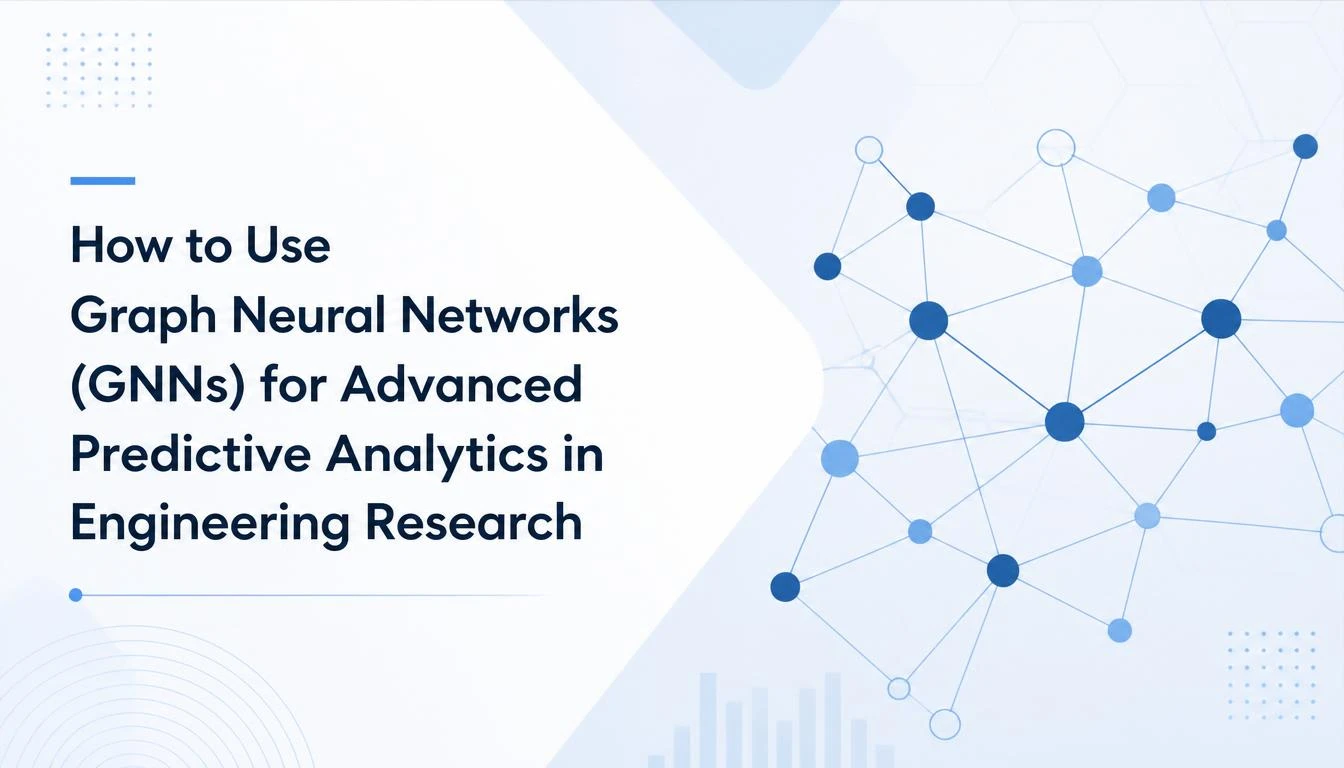
“Graph Neural Networks (GNNs) are revolutionizing engineering research by modeling complex, non-Euclidean data structures. Learn how to apply GNNs to supply chains, structural mechanics, and IoT networks for high-impact PhD publications.”
The Limitations of Traditional Deep Learning in Engineering
For the past decade, Convolutional Neural Networks (CNNs) and Recurrent Neural Networks (RNNs) have dominated PhD research in engineering. CNNs excel at grid-like data (images), while RNNs handle sequential data (time-series). However, many real-world engineering problems do not fit neatly into grids or sequences. Consider a power grid, a molecule, a supply chain network, or a 3D structural mesh. These entities are inherently graphs—composed of nodes (entities) and edges (relationships). When scholars attempt to flatten a graph into a matrix to feed into a traditional CNN, they destroy the rich topological relationships, severely degrading predictive accuracy. Enter Graph Neural Networks (GNNs). GNNs are deep learning architectures specifically designed to operate on graph structures. By passing messages between connected nodes, GNNs capture both the features of an entity and the structural context of its environment. For engineering PhD scholars aiming for high-impact Scopus Q1 publications, mastering GNNs is one of the most lucrative research vectors of the decade.
Understanding the Mechanics: Message Passing
The core mechanism of a GNN is the Message Passing Framework. In a traditional neural network, a neuron computes its output based on its own inputs. In a GNN, a node computes its state by aggregating information from its immediate neighbors. 1. Aggregate: Node A gathers feature vectors from its connected neighbors (Node B, Node C). 2. Combine: Node A combines its own current feature vector with the aggregated neighbor features using a neural network layer. 3. Update: Node A updates its state. By stacking multiple GNN layers, a node can eventually gather information from neighbors $K$-hops away. This allows the network to "understand" the global topology of the graph, making it incredibly powerful for predictive analytics.
High-Impact Application Areas for PhD Research
If you are structuring your PhD thesis around predictive analytics, here are three engineering domains where GNNs drastically outperform traditional models. 1. Civil and Structural Engineering: Mesh Physics Prediction Traditionally, simulating stress, strain, and deformation on complex 3D structures required computationally expensive Finite Element Analysis (FEA). In recent research, structures are modeled as graphs where nodes are physical coordinates and edges are material connections. A GNN can be trained to predict the deformation of the mesh under stress almost instantaneously, bypassing the heavy differential equations of FEA.
2. Electrical Engineering: Smart Grid Reliability Power grids are massive, dynamic graphs. Traditional predictive maintenance models treat each substation in isolation (using time-series forecasting). A GNN treats the entire grid as an interconnected system. If a transformer is exhibiting anomalous voltage, a GNN analyzes not just that transformer, but the cascading effect on connected transmission lines.
3. Industrial IoT and Supply Chain Logistics Modern manufacturing relies on massive networks of IoT sensors. Predicting equipment failure or supply chain bottlenecks requires understanding how a delay in Factory A impacts Warehouse B. By modeling the supply chain as a directed graph, GNNs can perform Edge Prediction (predicting missing links or future relationships) and Node Classification (classifying a specific node as "high risk" for failure).
Popular GNN Architectures for Researchers
Not all GNNs are created equal. Depending on your research data, you must select the appropriate architecture: 1. Graph Convolutional Networks (GCNs): The foundational GNN. Best for static graphs (e.g., molecular structures) where relationships do not change over time. 2. Graph Attention Networks (GATs): Introduces an "attention" mechanism, allowing the model to weigh the importance of different neighbors. Crucial for social networks or power grids where certain connections are more influential than others. 3. Spatial-Temporal Graph Neural Networks (ST-GNNs): Designed for dynamic graphs that change over time, such as traffic networks or brain EEG signals.
Implementing GNNs: The Tech Stack
For PhD scholars, building GNNs from scratch in raw PyTorch or TensorFlow is unnecessary. The open-source community has developed powerful libraries optimized for graph operations:
Writing Your GNN Research Methodology
When writing your methodology chapter for a GNN-based thesis, peer reviewers look for three critical justifications: 1. Graph Construction Justification: How exactly did you define your nodes and edges? (e.g., "Nodes represent intersections, edges represent roads, edge weights represent traffic density.") 2. Architecture Selection: Why did you choose a GAT over a standard GCN? (e.g., "GAT was selected because the influence of neighboring sensor nodes varies dynamically based on wind direction.") 3. Baseline Comparison: You must benchmark your GNN against traditional models (e.g., LSTM, Random Forest, CNN) to prove that the graph topology actually contributes to the predictive accuracy.
Conclusion
Graph Neural Networks represent a paradigm shift in how we analyze interconnected data. For engineering PhD scholars, pivoting from traditional ML to GNNs not only increases the novelty of your research but significantly boosts your chances of acceptance into top-tier IEEE and Elsevier journals. By understanding the underlying topology of your data, GNNs unlock a level of predictive intelligence previously thought impossible.